

I have always thought the phrase “cash for work” was kind of crazy. Isn’t cash for work called employment? In practice, however, cash for work is a specific kind of disaster relief where people affected by the emergency are paid to engage in reconstruction activities. That might include cleaning or rebuilding schools and hospitals, clearing roads, or digging latrines. If well-designed, cash for work programs support the rebuilding of a community and provide a much-needed cash infusion. If badly designed, they can disempower communities by not giving community residents a stake and a voice in how their own space is restored.
Month: October 2008
This job is not always fun
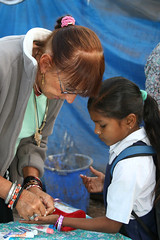
There are an awful lot of good things about a career in international relief or development. You accumulate great stories for parties, you sound cool as all get-out at high school reunions, and you have a valid reason to get extra pages in your passport. Plus, you know – you do meaningful work that you care about in amazing parts of the world. Based on the email I get, it’s a field lots of people want to get into.
For contrast, here are three things that suck:
1) You’re always understaffed. Pressure to keep overhead costs low means that you never, ever have enough people to do the work you are supposed to be doing. This means working overtime for free, or doing your work badly. Sometimes it means both working free overtime and doing things badly.
2) You know you’re a drop in the bucket. Actually doing something to solve global problems brings you face to face with the complicated and painful nature of global problems. It’s a whole lot easier to feel miserable about Somalia and then donate a lot of money to WFP than it is to be in Somalia and run a food program. Giving money to the organization of your choice feels like you are doing something with impact; working for that same organization will often feel completely futile. Perspective is not always a good thing.
3) You’re a bureaucrat. An awful lot of every expat’s job involves paperwork. Most people picture international work as feeding hungry people, providing health care to refugees, or building schools. In reality, it makes no sense to pay an expatriate to do that. Instead, we do what cannot be hired locally: English-language paperwork. We write reports to HQ and donors, proposals, and program guidelines. We write even more reports. We can go days without seeing anybody who is helped by our work.
(photo credit: pondspider)
Baghdad
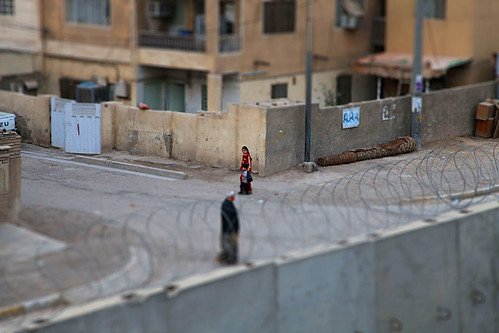
Just to be absolutely clear, I was only in Baghdad for a week, more than a year ago. A cushy week, at that, where I stayed in our compound, ate freshly-baked pastries, and asked the Iraq team a lot of questions about their work. I left the compound once to go to the green zone. We went directly back afterward. I had no close calls, no kidnap attempts, and no experience with live fire of any kind. I saw Baghdad through the window of our battered Mercedes and briefly from the roof of our apartment building.
I know an awful lot of people who’ve been to Iraq. Just about everyone at IMC, for one thing. My friend Kerry, for another. A monitoring and evacuation specialist who got sent home because it was too dangerous for non-permanent staff. My cousin, a Kuwaiti, who translated for UPI. A contractor who carried a secret gun so that “he wouldn’t end up in a video in CNN.” I am not trying to say I have anything in common with them.
I’ve just got me, and my experience. I went to Baghdad, I ate a lot of carbs, I listened to a lot of music on my laptop to drown out the explosions I could always hear in the distance. I was there the week the surge started and the Iranian ambassador was taken. I heard two bazaar bombings. I discovered mortar fire sounds just exactly like it does on M*A*S*H (the mortar fire is much louder near the green zone).
I remember every tiny detail of that trip. What the detergent in the sheets smelled like. The flavor and texture of the little cookies the cook made. And the music I played. One song in particular, I listened to many, many times. Love is the Movement. I’ve got it on my iPod. I still love the song, but it gives me nightmares. I flinch when I see it on my playlist, and I always listen to it anyway.
Iraq was real. We were doing work that really, really mattered there, and it was some of the best work that can be done in Iraq. If we hadn’t been doing it, no one else could have. (You don’t, honestly, feel that way all that often. Usually you know that if you don’t do it, World Vision or CARE probably will.) I talked to my colleagues in that office – who were, to a person, traumatized and shell-shocked – and they were utterly committed to what they did. They knew their work had damaged them and they thought it was worth the trade-off.
If I didn’t have my son, I’d still be in that office today.
I heard Love is the Movement on my bus ride home. I donated some money to my former employer this evening, and I did the thing I hate and designated it for Iraq programs. I’m going to wake up crying tonight.
Dear everyone who’s ever thought of starting an NGO
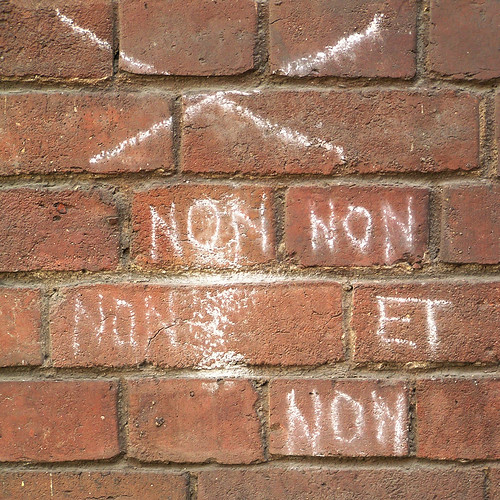
Don’t do it. You’re not going to think of a solution no one else has, your approach is not as innovative as you think it is, and raising money is going to be impossible. You will have no economy of scale, your overhead will be disproportionately high, and adding one more tiny NGO to the overburdened international system may well make things worse instead of better.
Now that you’ve ignored me, here’s the rest of my advice:
1) Make your bones. Go work for an existing NGO that addresses the same problem, or one like it. Learn from the existing knowledge in the system so you don’t waste time re-inventing the wheel. If you’re not qualified to work for an existing organization, you’re probably not qualified to run your own.
2) Identify a new funding source. If you’re just going to compete for the same donor RFPs and RFAs that everyone else does, you’re not bringing anything new to the world. If you didn’t get that grant to reduce child mortality in Liberia, another organization would. The children of Liberia benefit equally either way. If you can bring new money in, then you’re having a genuine additional impact.
3) Hire experienced people to work with you. There is a certain charm to a bunch of inexperienced people trying to change the world together, but a group that combines new ideas and actual experience can produce genuine innovation.
4) Your finances are probably the most important part of your NGO. Your donors will want to see your financials before they give. Your projects will require a steady stream of reliable funding to succeed. You can’t do good if you can’t pay your bills.
(photo credit Mosieur J.)
Five mistakes international organizations make when using Twitter

1. Using it just for press releases. People don’t follow you on Twitter for generic organizational announcements. They follow because they want to feel a personal connection with what you do. They want to become friends and allies. Write your Twitter updates in less formal language, and tweet little things, too. Not just press releases. Welcome new employees, for example, or tell them a little bit about one specific project.
2. Only asking for money. Constant calls for funds will bore people and cause them to unsubscribe from your Twitter feed. Ask for money no more than once a week, and when you do, tie it to something you mentioned that week.
3. Not following back or replying to others. As an organization, you should automatically follow back anyone who follows you on Twitter. People don’t want to be broadcast to; they want to be part of a conversation. Following people is the first step; the second step is paying attention. Use Twitter search to monitor mentions of your organization. Reply to those mentions. Periodically read the postings of people you follow. You don’t have to read every post, but check in from time to time, and reply if you have something interesting to say.
4. Forgetting the global audience. Twitter has a worldwide user base. This includes people in the countries where you work. It may include potential donors and beneficiaries in other countries. It will definitely include your own staff. When you write about events in, say, Rwanda, assume Rwandans will be reading. Are you still comfortable with your post?
5. Not having a Twitter strategy. There are things to think about before you post your first tweet. Do you want to encourage all your staff to have organization-linked Twitter accounts, or just a single account to represent the whole organization? What aspects of your organization do you want to highlight? What kind of expertise do you possess and can showcase? Who will update the Twitter account, and will all postings need to be approved first? These are issues that can be resolved with some planning, and can go very wrong on you without some advance thought.
Links: jargon, politics, humanitarian relief, and a contest
This glossary is a resource for deciphering development jargon.
The Huffington Post asks if Republicans are better at foreign assistance.
Statistics on humanitarian relief from the excellent new Change.org humanitarian relief blog. I have been very impressed by the blog so far; it’s a great combination of information, editorial, and links to useful resources.
Lastly, I’ll hop on the bandwagon and link to the USAID Development 2.0 Challenge. USAID will award a $10,000 prize for a high-impact use of mobile technology for development. I think this contest will be very interesting to watch – the small prize level should bring out fresh ideas and not just proposals from all the same USAID grantees.
Blog Action Day 2008: Poverty
Everything that matters in international development comes back to poverty. Poverty saps your ability to affect the path of your life, stay (or start out) healthy, find a job, or invest in education or a small business.
Information on global poverty:
Dani Rodrik talks about international poverty.
A nice Foreign Affairs article on reducing global poverty.
The World Bank’s most recent numbers on global poverty.
Oxfam’s take on reducing global poverty.
You will notice that not all of the sources I have listed agree with each other. Poverty is a complex topic, and there are no obvious answers on what to do. If you want to get involved in fighting global poverty, I suggest the ONE campaign. If you’d like to donate money to help alleviate global poverty, give to an NGO you already know and trust. Poverty is part of all our major problems, and fighting it is part of every solution. Donate to a food pantry in your home town, to Feeding America, International Medical Corps, or the Treatment Action Campaign or Oxfam. Every NGO trying to make the world a better place is fighting poverty one way or another; choose one that is credible and give what you can.
Blog Posts I’ve written that touch on poverty:
Suffering does not make you special
Your money does not make you special
Why health matters (if you only read one of my posts, read this one)