International Development on Twitter, Part II – Five more people to follow


Joseph Kimojino @maratriangle

Why you should follow: Fascinating first-hand account of wildlife protection in the Mara Triangle, complete with catching poachers, making tourists behave, and helping wounded animals.

Sample Tweet: Three poachers arrested two nights ago and poaching activity seen in Mingu area. 14 snares collected this morning.

Appropedia @appropedia

Why you should follow: A constant stream of interesting information on useful technology.

Sample Tweet: A miracle substance that’s cheap & could add 1 billion points to the global I.Q.: iodised salt. http://is.gd/aMz5

Usha Venkatachallam @nadodi

Why you should follow: Great posts on information technology and the developing world.

Sample Tweet: mix a nerd & humanitarian news. result = AidNews, AidBlogs, and a how-to blog post. http://bit.ly/QeCJ

Gaurav Mishra @gauravonomics

Why you should follow: Links and thinking on social media and ICT for development.

Sample Tweet: Preparing for a talk tomorrow on the role of citizen journalism in crisis reporting for my fellow associates at http://isd.georgetown.edu/


Jon Camfield
@joncamfield

Why you should follow: Interesting information technology information, and great coverage of One Laptop Per Child.

Sample Tweet: TCO for low-cost computing in Education: The video archive of last Thursday’s discuss. http://tinyurl.com/6xwe8n

As always, let me know who I forgot in the comments.

*****
(photo credit: Steve Woolf)
Chosen because it was either this or the fail whale.

International development on Twitter, Part 1


Ten people to follow on Twitter if you’re interested in international development. Not the top ten, necessarily – there are too many great people on Twitter for me to make that claim. But ten microbloggers who consistently engage my attention with interesting ideas:

Glenna Gordon
@Scarlettlion
Glenna Gordon is a journalist, photographer, and author of the Scarlett Lion blog, currently living in Uganda. Her writing, and the links she posts, offer beautifully written insight into Uganda, with a solid dose of cynicism and wry humor.

Sample tweet: Supermodel risks TB and Genocide by visitng Rwanda: Monika Schnarre, who considers herself a supermo.. http://tinyurl.com/65aymn

Why you should follow: For links to photos and articles on Uganda, Africa, and development which you wouldn’t have found on your own.

Chris Albon@chrisalbon
Chris Albon is author of the amazing War and Health blog, and posts a great series of links on war and conflict.

Sample tweet: For the past 2 weeks I’ve been writing post on armed groups potentially exploiting Ushahidi. This is what I mean: http://tinyurl.com/56bes7

Why you should follow: For links to a huge range of articles and resources on conflict in general and conflict and health. He’s obsessed with the intersection of war and health, and obsessed people make great reading.

Vasco Pyjama
@vasco_pyjama
Vasco Pyjama
is an aid worker who’s been everywhere, including Somalia and Afghanistan.

Sample tweet: Documenting lessons learnt and writing up methodologies. At first I thought I had indigestion. Now I realise it’s heartache.

Why you should follow: For a self-aware, intelligent, first-person perspective on aid work and its discontents.

Glenn Strachan@glennstrachan
Glenn Strachan travels the planet supporting ICT for development. He blogs as well as using Twitter.

Sample tweet: Right now I am trying to assemble a list of the top 30 organisations worldwide doing work specifically in ICT4D. There is no list.

Maneno @maneno
The twitter account of Maneno.org, which is devoted to making African voices heard.

Sample tweet: Toivo Asheeke’s latest post on his Maneno blog, “A Brief Case Study of A Successful African Country” (Namibia) http://tinyurl.com/6mste4

Why you should follow: To keep your news sources broad and deep.

I’ve got five more profiles coming up in my next post: @maratraingle, @chriswaterguy, @nadodi, @guaravanomics, and @joncamfield. Who am I missing? Tell me in the comments.

***
(photo credit: FunnyBiz)
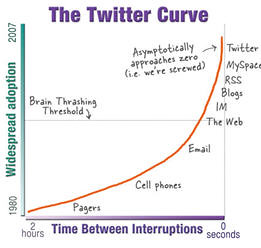
Chosen because I love graphs.

Jargon of the Day: Operationalize


Jargon: Operationalize

Translation: This piece of jargon bugs me because it used to have a meaning and it doesn’t any more. The original meaning was pleasingly specific and complex. It meant finding a way to measure a nebulous concept. For example, you might want to measure a nation’s level of happiness. You could operationalize that – find something to measure – by using the number of cheerful songs played on national radio, or the number of depression diagnoses.

That useful definition, however, is now long gone. Instead, operationalize means whatever people want it to mean. Usually they use it to mean something like implement, operate, or do.