Things I believe in #33 – Skype

I believe in Skype.

For those of you who don’t know, Skype is a program that lets you make phone calls over the internet. Calls are free if you call someone else running Skype, and cheap to a standard phone line. Skype also works as an instant messaging program. It’s secure, and it’s instantaneous.

I love Skype. It lets your employees scattered around the world feel like a single team. It can erase the divide between field and headquarters by making communications less formal. Using Skype phone, you’ve got time to chat a little before doing your business, because you’re not costing money or burning cell phone minutes. Using it as an instant messenger, you can pop off a quick informal question whenever you need to know something.

Easy, informal communication builds relationships. It connects your people, and makes them feel like they’re part of something. It makes your reports more useful, your programs better designed, and your grant proposals more accurate. It lets your respond more quickly in a crisis, and change your projects if they’re not working.

A caveat – you need to be a well-managed and an utterly transparent organization to use Skype well. Skype will reveal the fault lines of your organization very, very fast. When gossip can shoot across the globe in the blink of an eye, nothing stays secret for long. Unhappiness or fear will spread from person to person like a virus, and mistreatment of one employee will soon be known to all.

Jargon of the day: Burn Rate

Jargon: Burn Rate

Meaning: How much a development project spends each month, or each year. You need to keep an eye on your burn rate to make sure that you’re not going to be overspent by the end of your project or not spend all your money and have to give it back to the donor (and do less work than you could have.)

Not everyone is a sociologist

You can’t just choose any random person to be your cultural guide. It makes me completely crazy when people say “My Luisitanian colleague says our poster and brochures are fine” and then assumes their messages are acceptable in Luisitania. One person cannot vouch for everyone in the country.

Most countries are multicultural, including different ethnic and linguistic groups. Not to mention differences between rich and poor, and city and country. It’s not easy to know the tastes and opinions of an entire nation. There’s also a training issue. Your average engineer or doctor from the capital city isn’t in the habit of thinking about the attitudes and mores of everyone around him. An accountant is not an anthropologist.

Most of us can only speak for a limited number of people like ourselves; coming from a developing country doesn’t give you any magic ability to speak for everyone who holds the same passport.

ETA: One great example. The Indian Vogue fashion spread discussed here was designed and shot by Indians.

Humbling Hospitality Experiences


1) I once did a focus group with women in rural Tajikistan, talking about increasing hunger and food insecurity. The women told terrible, desperate stories, of burning fruit trees for warmth and watching their kitchen gardens wash away in heavy spring rains. At the end of our discussion, three different women invited me to come home with them for a meal. They did realize the irony; one woman said, shyly, “I don’t have any fruit or sweets, but I have bread and tea.”

2) In 1997, I went to Jerusalem for Thanksgiving. My wallet was stolen. I told a Palestinian shopkeeper in the old city what had happened to me, and he took me into my shop and made me a cup of tea. Then he told the managers of the shops around me what had happened. Shop employees came, and brought me money. Small amounts – 5 or 6 shekels (about $2) each, but these were not people who had a lot of money. They brought me, a rich American by any standard, money, because I was alone in their country and needed help.

3) When my husband and I lived in Turkmenistan, we had a good friend, Katrina, who was a Peace Corps volunteer. Her host family treated her as a true daughter, and she reciprocated their affection. When the government marked their house for demolition, she helped them as they packed their things and got ready to move to the apartment they were being given in return. In the same period, I was re-posted to Tashkent. Katrina’s host family was determined to have us over for a meal before we left, since we’d never eaten there. We would be leaving before they moved into their new place, so they had us over to their house.

They had us over for dinner as their house was being torn down. The house had been two stories, but was down to one. It was raining that night, and the roof in the living room leaked, since it wasn’t really a roof; it was just the floor to the second story. Katrina’s host mom moved us to the kitchen, and sat us at the kitchen table while she made lamb pilaf and salad for us. We ate, all together, in the corner of the warm damp kitchen.

You can always find a way to give, if you want to.

Photo Credit: Turkmen soda pop, taken by me

How to help in Georgia

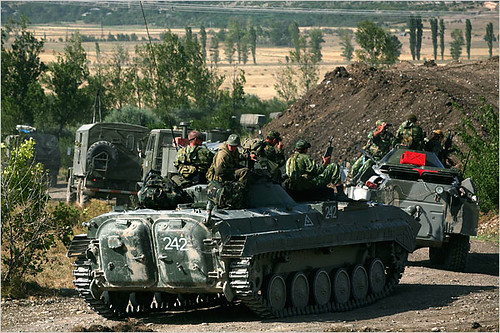
Georgia is a developing country, but not among the poorest of the poor. It’s not Haiti or Bangladesh. Therefore, the displaced persons who fled probably have some level of savings, and left with some household items. They’re not going to be at immediate risk for starvation, but things will get very tough for displaced persons in about a month. After that, the major risk is winter. Cold weather in the Caucasus is extremely cold, and displaced persons are likely to be in inadequate housing without the funds to pay for heating fuel or the clothes and blankets needed to keep warm.

If you want to provide help to displaced persons, I offer the same advice I always do. Find an NGO that already operates in the region. I suggest CARE, which has been in Georgia for about 15 years, and CHF, which also has an established presence. Give to the organization’s general fund, so your funds will be used as effectively as possible.

You may also want to think about other victims of the crisis. Consider supporting groups who assist and protect ethnic Georgians in Russia, and ethnic Russians in Georgia. By all accounts, the nationalism is getting ugly on both sides, and resident minorities will be at risk. I suggest supporting the Open Society Institute’s (OSI) Russia organization to help ethnic Georgians in Russia and OSI’s Georgian arm for the inverse.

Lastly, I suggest supporting civil society, human rights, and independent media in both countries. Democracies don’t go to war like this.

Photo: Joao Silva for The New York Times

Jargon of the day: Monetization


Jargon of the Day: Monetization

Meaning: Monetization means something slightly different in a humanitarian and development context than it does in social media. In this case, it means selling food aid commodities in order to take the money and fund non-food projects. Many, perhaps most, food aid projects are actually monetization projects. It’s often the most useful thing to do with donated rice or flour.

I hate this word because it keeps you from thinking about what a convoluted process selling commodities actually is. It’s a tidy, professional-sounding word that covers up the fact that we are taking American-grown commodities, selling them in foreign countries, and then using the money for projects. Perhaps we should just donate money in the first place?

Five things everyone really ought to know about already

Kiva.org was actually the inspiration for this list. I thought everyone in international development had heard of Kiva by now, but apparently that’s not true. A former colleague of mine was wishing she could find a way to give to Tajikistan in a way that let her see impact. I suggested Kiva, and was met with total blankness, because she’d never even heard of it. That made me think of all the other stuff I thought was obvious. Therefore, I bring you:

Five things everyone really ought to know about already

1) Kiva.org

Kiva is an NGO that supports microlending. Individual entrepreneurs are listed on the site, with a description of how much money they need and the projects they want to invest in. You can then choose who to support and how much you want to lend. Kiva devotees are passionate and vocal, and the lending experience is an awful lot of fun. Kiva consistently has more people who want to loan than qualified borrowers.

I think this kind of personal choice and connection is going to be important in the future of global charity. Combining the personal link with micro-credit is sheer genius, and it’s something we can all learn from.

2) Global Giving

Global Giving is an aggregator aimed at people who want to donate to global causes. You can search by location, topic, or though a nifty little donation wizard that helps finds projects to suit you (which introduced me to the concept of microhealth insurance). From a donor’s perspective, I love the idea of finding causes to support in a logical way that lets you do research, instead of waiting for someone to come to you and solicit a donation.

From an NGO perspective, this is a great way to gain committed donors who have genuine passion for what you do. For a small NGO, this is an amazing opportunity to access funds without having to invest in a fundraising infrastructure. Global Giving and organizations like them are the wave of the future.

3) RSS Readers

RSS is an acronym for a name that doesn’t really matter. The important thing about RSS is that it brings the content of websites to one place so you can read them easily. I use Google Reader, because I’m lazy, but there are a lot of choices. Just search for RSS Reader, and see what you come up with. By bringing everything to one place, it makes it much easier to keep up with new web content, saving you time and effort. Most of the smarty-pants people you meet who seem up-to-date on everything use RSS readers to accumulate all that knowledge. It’s hard to explain exactly why it’s so much easier to use one reader instead of visiting each site individually, but trust me, it is. Give it a shot and see for yourself.

4) Google alerts

I love Google alerts, which are basically searches that Google saves and runs for you on some kind of regular schedule that you select. You are emailed the results. I put a Google alert on any topic that seems like it might interest me – my current list includes several countries, “public health,” “maternal health,” and several other terms. If I’m not getting anything interesting, I dump the alert. I also have Google alerts set up for colleagues, former colleagues, and anyone else I want to keep up with, as well as my current employer and former employers. My Google alerts are the long-term memory I wish I had, remembering to hunt down information on everything I’m interested in, and they’re my antennae that sense information about what’s new in the world.

5) Twitter

Twitter.com is a microblogging site, where you can set up an account and post updates of up to 140 characters. It is a little like Facebook, because you sign up to “follow” people who interest you, and acquire followers of your own. I use Twitter to give people a sense of me as a person, to highlight web links that don’t quite fit in with my blog, and to flag things that I plan to expand into blog entries later.

The sense of community is powerful and addictive. I post the link when I write a new blog post, along with the topic, and a lot of people come over to check it out. People will often respond immediately and send me links they think I will like. I also use twitter for brainstorming – it gives me a chance to ask random questions and get immediate answers from a whole herd of interesting people.