
Blog posts I am apparently never going to write

Linus Pauling Photo

I have started all of these posts more than once, and I never seem to get them fully written up. Therefore, some half-baked ideas for your consideration.

1. How I learned to love the MDGs

I used to think the Millennium Development Goals were a cruel cheat. I thought that since they were set too high to actually achieve, they were dooming developing country governments to failure and disillusionment. It turns out, though, that governments are used to missing their targets. And the MDGs make sure that everyone is aiming for really good targets. So I take it all back. The MDGs are pure genius.

2. Why I don’t hire development studies majors

Because the degree doesn’t leave you with any actual skills – maybe it would be useful for someone who’s been working in development and needs a frame. But it is not preparation for international development work. Learning a whole chunk of development theory has remarkably little to do with the actual work of improving lives and creating better opportunity.

3. All volunteers are not the same

Whether or not you get paid has nothing to do with your skill set. Volunteers are capable of doing vital work extremely well. However, they may also be unskilled, unqualified, and damaging to the programs and communities that take them on. It is very hard to use volunteers well because they tend to want a short-term commitment so you lose a lot of time training and integrating them, and because often people with relevant skills get paid jobs in development. Long-term volunteers are more likely to be useful than short-term volunteers.  Volunteering has more impact the closer to home it gets, because the learning curve gets shorter and shorter.

4. International development is difficult

It’s hard, it’s expensive, and we have trouble knowing what works. We make the same mistakes over and over. I have seen individual projects that actually succeeded but I honestly don’t know what theory of development is most likely to be true. (Though I do think people believe anything they see in a soap opera. Is that a development theory?) This field feels sometimes like medicine back in the age of leeches and bloodletting and I have no idea if Jeff Sachs, Paul Collier, or Bill Easterly is going to turn out to be Louis Pasteur or Linus Pauling.

5. The official list of crushes on development thinkers, as confessed to on Twitter:

  • Hans Rosling
  • Mohammad Yunus
  • Amartya Sen
  • Ruth Levine
  • Robert Chambers

******************

Photo credit: Wikipedia – Doesn’t Linus Pauling look handsome and idealistic? No clue at all he’d turn into a Vitamin C quack at the end of an illustrious career.

What we can’t do, part II

One person can never do enough. It’s a truism, and a dull one at that, but living that inadequacy is a whole new deal. In the US, you can mostly ignore the pain and inequality in your life. You can go from home to car to office to car to home again, and only encounter other middle class people. You don’t see the sweatshop laborer that made your clothes, or the environmental impact of the pollution caused by your car.

You don’t get a bubble in poor countries. The sick, starving, and unemployed are your friends and neighbors. Kids swarm your car to beg for money in the street. The pollution hangs in the sky and makes you cough black. Your staff members need more days off to attend funerals than you could have ever imagined. There is no way to pretend you’re not living in a world of colossal needs; that everyone is as comfortable as you are.

That never stops being painful for me, and I know I am not the only one. There are a few time-honored ways of dealing with the problem. You can try to tune it out – focus only on your job and refuse to notice all the other needs. That turns pretty quickly to blocking out the entire world you live in. You can refuse to think about it at all, but that turns pretty quickly into refusing to think about everything. Or you can tell yourself a story to help you accept your tiny little place in the world. A story helps give yourself some kind of handle to hang on to when the big eyed children with malnutrition-orange hair beg you for bread and candy.

I’m a storyteller, myself. A good story about what I am doing and why it’s worth doing it can take me through a long of dark nights of the soul. I define my project, and its immediate impact. Then I try to think about the ripples it may have, spreading out into the world. It’s not that my work is necessarily the most important work, or the only work that matters. But it does matter. Insert your metaphor of choice here: starfish on beach, candle in darkness. Sisyphus and his rock, by the way, are not a good metaphor choice.

I have other types of stories for other types of projects. International development is powerfully complex. Everything is linked, often in ways you wouldn’t expect. Situating your little effort into a large whole is easy. Education projects are essential because educated people improve economic growth and are healthier. Agricultural development efforts can prevent small farmers from starving and improve GDP. Even something as technical as land reform ties into state stability, agricultural support, and individual empowerment. I tell myself a story for every project I work for. I find a reason to love my work, and I hold to that reason.

So I had an answer for my office manager – I had my own story. I told him you can’t change the world when your child is sick. You can’t start a business, run for political office, or form a community association. All you can do is try to save your child. That’s just the nature of the human heart. And by helping the children of Uzbekistan be happy and healthy, we were freeing up a lot of human energy to make the country a better place.

The office manager accepted my answer. At least, he seemed calmer after we talked. He kept going. He didn’t do anything drastic like quit his job or emigrate to Russia. But I am willing to bet he’s still haunted by the problems he can’t solve in Uzbekistan. Just like I am.

What we can’t do, part I

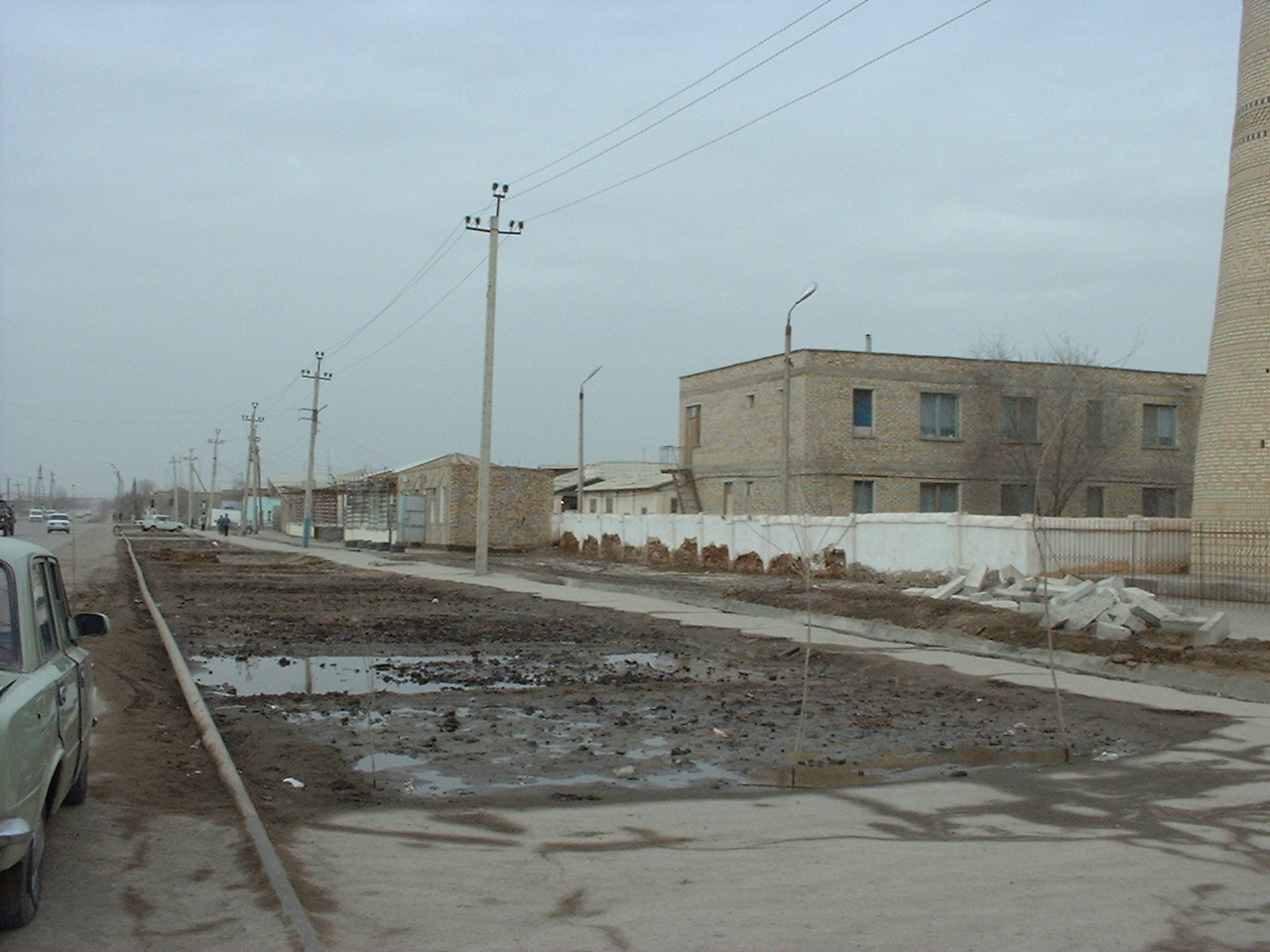
Thdepressing picture of a muddy streetere have been an awful lot of people I haven’t been able to help. My career feels, sometimes, like a long list of things I haven’t been able to do, punctuated by the occasional success.

I know that isn’t unusual. When you live in a poor country, you are constantly assaulted by the terrible need of the people around you. Our ability to respond is limited by so many things – program scope, funding, human capacity and host country conditions – just to start. There is never enough money to do everything, or you need to branch out into some new area you know nothing about. Sometimes the problem is caused by destructive traditional practices or bad government regulations.

At times, you can’t help people because you failed. Your program just got it wrong. You trained doctors but they didn’t change their behavior afterwards. You wasted your money and their time and no patients benefited. Or the broiler chickens turned out to cost more to raise than they earned when you sold them. Or your families sold the vegetables from their kitchen gardens and used the money to buy sugar and children’s nutrition actually got worse.

You can make bad choices with the best of intentions, you can discover your every choice has unintended consequences, and you can just be flat out stupid. Luckily, we’re not houseflies. We have the capacity for learning. And if we’re willing to genuinely examine our failures, we can avoid making the same mistake twice. It’s hard, but it’s possible.

I’m not saying that failure is a good thing. No one wants to waste their limited resources – time, money, and community commitment. And most of the time failure isn’t failing well – it’s just an ugly mess. But you can learn to fail well, and over time most of us learn how to.

For me, at least, it’s not failure that devastates. It’s the sheer scope of the problems we face and the tininess of our ability to help. Even the most holistic project has its limits. You simply can’t tackle everything all at once. But as you live your life, everything all at once is what you see.

When I was living in Uzbekistan in 2005, there was an incident in a conservative city, Andijon, in the Ferghana valley. A protest got out of hand, leading to a break-in at the city jail and a massive demonstration in the main square. When the police got involved, it ended in violence. Somewhere between 169 and 700 people were killed. The Uzbek government holds that those who died were terrorists; NGOs in the country report deaths among innocent civilians, including women and children. It’s been a source of a lot of controversy.

Nobody, however, denies that it was bloody, terrible, and heartbreaking. The deaths in Andijon left the whole country stunned. My office manager came to me in tears; he was thinking of quitting his job. What is the point, he wanted to know, of running a health project when there were so many other things going wrong in his country? Training pediatricians struck him tiny and useless.

He had a point. Most of what we do is tiny and pointless in the grand scheme of things. One average-size project isn’t going to have much impact on an entire country. That is brought home to us every day, all the time, as we live and work in the developing world.

If you’re working for an HIV project, helping people access anti-retrovirals, you know you’re saving lives. If you visit a clinic that is giving out the drugs, you can actually watch people get healthier over time. But what about all the people who don’t have AIDS? What about your neighbor, whose mother has cancer and there is no treatment available in the country for it? What about your friend’s son, who has no way to pay for university? What about the woman down the street, who always has bruises and you can hear the shouting in her house? And the children begging in the street, or the local school which has no windows or books?

(photo credit: me)